.png)
Kalaripayattu is an integral part of India’s national heritage and a popular martial art practiced by millions of people around the world.
Also known as just “kalari”, the practice is a unique mixture of traditional martial arts practices that include weapons, spiritual elements, and healing methods. It was created as a comprehensive military combat system that covers all the scenarios soldiers may face on the battlefield.
In this article, we are going to bring you closer to Kalaripayattu, its rich history, and its unique concept, and explore its effectiveness in real combat.
The History of Kalaripayattu
Kalaripayattu emerges from mythology stories about Sage Parasurama and Lord Shiva. According to local legends, Parasurama, the sixth avatar of Vishnu, developed this martial art after receiving divine teachings from Lord Shiva, and his first students were settlers of Kerala.
Early history
In its early history, during the Sangam period (600BCE-300CE), it started to spread in the ancient Indian state of Kerala, where it became a vital component of military training. Soldiers learned how to use swords, knives, and spears and ride horses or elephants.
Kalaripayattu training became more formalized during the medieval period (11th to 15th century). It quickly became an integral part of Kalari society, where training was present in every village and used as a method to keep the people in shape, ready for war, and disciplined.
The first matches or duels between two individuals started to be organized in the late medieval period. Initially, these duels were used to settle disputes between people in a controlled and safe environment. However, severe injuries and deaths were quite common.
Medieval period
During the medieval period, the art witnessed exponential expansion as other regional kingdoms integrated it into their military strategies. This period also marked the standardization of various techniques and codified their distinct styles.
Kalaripayattu faced a downturn in the early modern period due to political instability and foreign invasions that happened after Vasco da Gama discovered a new route from Europe to India. However, a resurgence occurred in the 20th century, mainly thanks to enthusiasts who played a crucial role in revitalizing the practice.
In the 21st century, Kalaripayattu transcended its martial origins, evolving into a holistic discipline of physical and mental well-being. It is practiced worldwide by thousands of people looking to grow and improve their quality of life through martial arts practices.
Kalaripayattu Techniques and Concept Explained
Kalarippayattu is a hybrid martial art and a mix of armed and unarmed techniques. This includes striking with all limbs, usage of light armor, and weapons such as swords and spears. In contrast to other martial arts, practitioners first need to master weapon-based skills before moving on barehanded moves.
Kalaripayattu Concept
Kalarippayattu is a martial art that combines armed and unarmed techniques with healing practices. This includes striking with punches and kicks, grappling moves, and weapons such as swords and spears. Since the system focuses on actual combat, practitioners learn to execute each move explosively and aggressively.
The learning syllabus adopts a unique approach where practitioners focus on mastering weapon-based skills before moving on to barehanded techniques.
Depending on the style, the learning syllabus might also include Yoga meditative practices as well as folk dancing.
Kalaripayattu Techniques
Kalaripayattu is a hybrid mix of striking, grappling, weapon-based techniques, and healing methods. It is a comprehensive system that covers most scenarios practitioners face in real life or on the battlefield. The majority of kalari schools emphasize traditional methods of teaching, and the learning program includes the following groups of techniques:
- Meippayattu — is a physical training designed to improve practitioners’ overall fitness. This includes different strength and endurance workouts and stretches that improve flexibility.
- Kolthari — involves practice with wooden weapons such as staffs, sticks, and wooden swords, which simulate the real ones made out of metal.
- Angathari — involves practice with metal weapons reserved for senior students. This includes metal swords and daggers.
- Verumkai — are hand-to-hand striking and grappling techniques. Practitioners learn different punches, kicks, throws, takedowns, and how to fight on the ground using joint locks and chokes (neduvadivu).
- Marmashastram– is a practice where practitioners learn how to attack 107 vital points in the human body, of which 64 are deadly.
- Chuvada — is a set of forms where students practice techniques alone in a relaxed and focused manner.
Kalaripayattu Training Regimen
The training ground is one of the most important aspects.
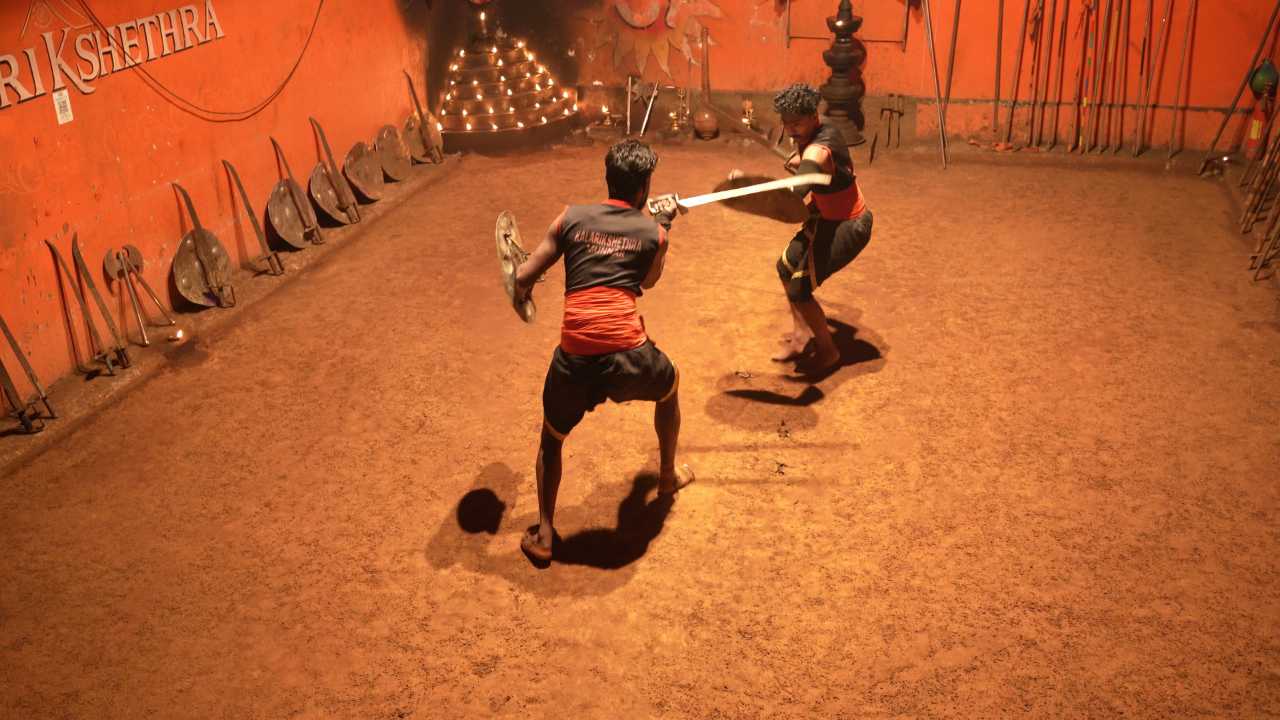
Kalaripayattu is traditionally practiced in special training facilities named “kalari”. These schools must be built in unique locations and according to Hindu architectural treatises so the entrance faces the east.
The floor is covered in red sand, mixed with different herbs believed to heal small wounds suffered by practitioners during intense training sessions. This mainly includes skin burns caused by friction.
Training is dynamic, playful, and intense. It includes a lot of physical training, solo and partner drills, fight simulations, sparring, and forms. The emphasis is on weapon training using staffs, wooden and metal swords and spears, and drilling offensive and defensive strategies.
Yoga and Traditional medicine
Apart from martial arts techniques, the Kalaripayattu concept also involves constant learning about the human body and developing healing practices. Before and after each session, teachers use different oils, herbs, and massages to treat muscular injuries and increase flexibility.
The concept is also connected with Yoga and dancing practices, which are integrated into training. So apart from combat techniques, practitioners do different types of Yoga stretches and breathing exercises to reach a meditative state of mind and improve the range of motion.
They also incorporate dancing moves during sparring to make their performance more acrobatic. The Southern style mainly characterizes this.
Traditional Uniform
The uniform is called “kachakettai”. It consists of a loincloth that comes in two colors — red and white or red and black. The traditional uniform also has different variations based on style and region and is typically made out of breathable and light materials. Practitioners may also wear armbands and anklets, and they traditionally perform barefooted.