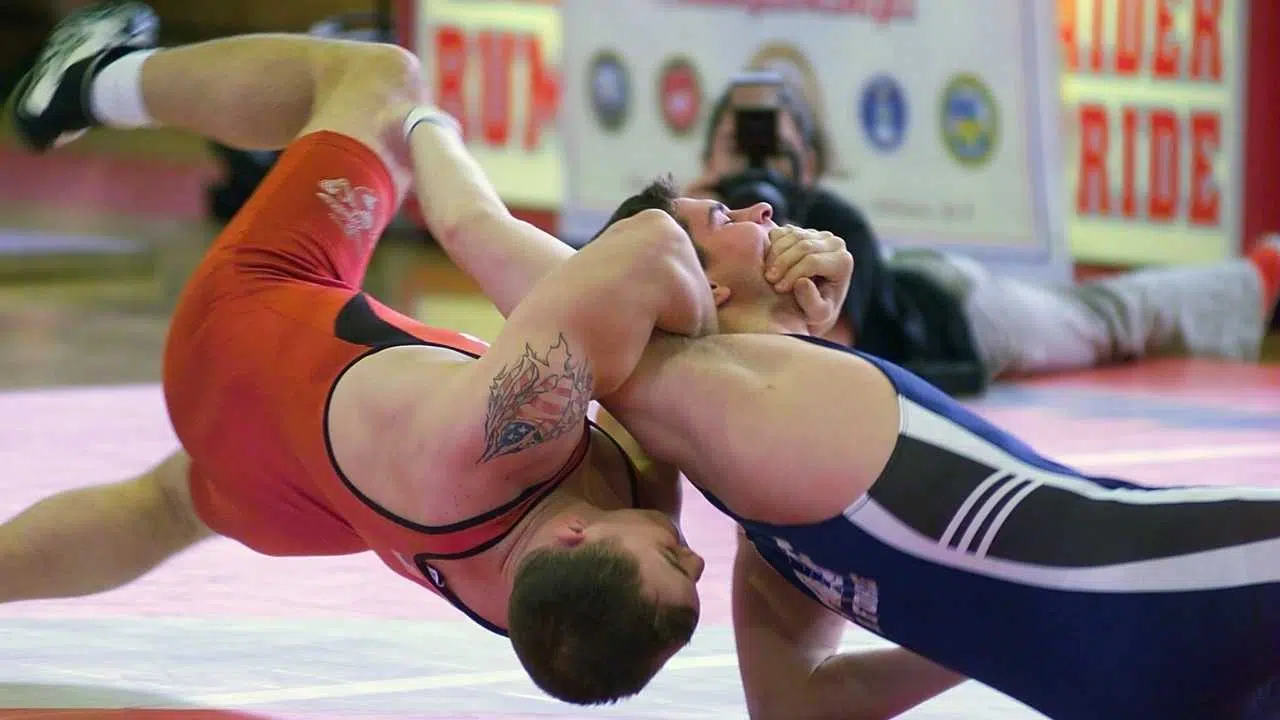
Freestyle wrestling is the most popular and practiced wrestling style in the world today. It is practiced on nearly every continent and is one of two wrestling styles that is an official Olympic sport.
Freestyle wrestling is an exciting sport with a storied history that really isn’t that old. Here is our complete guide for freestyle wrestling.
We’ll go through the history of freestyle wrestling and list some of the greatest freestyle wrestlers of all time. We will also answer some common questions that people have about freestyle wrestling.
What is freestyle wrestling?
Freestyle wrestling is one of the most popular forms of wrestling practiced in the world today. It evolved from catch wrestling and Irish collar wrestling in the late 1800s.
The first official freestyle wrestling competition was held at the 1904 Olympics and has continued growing from there. Freestyle wrestling is one of only a handful of wrestling styles practiced and competed in internationally.
The History Of Freestyle Wrestling
The history of freestyle wrestling actually isn’t that old. It evolved during the late 1800s from catch as catch can wrestling and Irish collar wrestling.
Catch wrestling was the most popular form of wrestling during this time. Many immigrants from the UK and Europe practiced catch wrestling, and many Americans adopted the catch style.
Freestyle wrestling started as a bit of an offshoot of catch, but submissions weren’t allowed. Positions like the all fours or turtle position were adopted from Irish collar wrestling.
At first, freestyle wrestling wasn’t really as popular as Greco-Roman-style wrestling that dominated the era. It wouldn’t be until the beginning of the nineteenth century that freestyle wrestling began to take hold.
Freestyle Wrestling In The 1904 Olympics
Before the 1904 Olympics, Greco Roman wrestling was already an Olympic sport, but another style was to be added. Initially, the second style of wrestling that would become an Olympic event was catch wrestling.
Unfortunately for catch wrestling, the Olympic committee didn’t want submissions in the event, and the rules were altered. That was how freestyle wrestling became an official Olympic event.
The rules of catch wrestling were altered to contain no submissions. In the newly formed freestyle wrestling rules, a competitor could either win by pin or by earning the most points.
All 40 participants in the first freestyle wrestling event were Americans.
Creation Freestyle Wrestling Rules & Point System
In 1921, the United World of Wrestling (UWW) created official rules for freestyle wrestling. These rules would be adopted by the Amateur Athletic Union (AAU) and become the official rules for all freestyle wrestling competitions.
Twenty years later, in 1941, the head coach of the Oklahoma State wrestling team created the freestyle wrestling points system. This point system became the official point system used by all freestyle wrestling organizations and governing bodies.
Other Countries Adopt Freestyle Wrestling
Since the creation of freestyle wrestling, numerous other countries have adopted this wrestling style. Some nations have even become quite known for their prowess in freestyle wrestling.
Some of the top countries that practice freestyle wrestling other than the US include: Russia, Iran, Cuba, Turkey, Japan, and Azerbaijan.
Freestyle Wrestling vs Other Wrestling Styles
Freestyle wrestling has some very specific rules that set it apart from other styles of wrestling. Here are the differences between freestyle wrestling vs Greco Roman, folkstyle, and catch.
Freestyle Wrestling vs Greco Roman Wrestling
Next to freestyle wrestling, Greco Roman wrestling is the second biggest form of wrestling in the world. They are the only forms of wrestling that are Olympic events, but that’s where their similarities end.
Greco Roman has a completely different ruleset than the one implemented in freestyle wrestling. In a Greco Roman wrestling competition, you are only allowed to take an opponent down from the waist up.
Freestyle wrestling’s rule set allows takedowns from the head to the feet.
Folkstyle Wrestling vs Freestyle Wrestling
Freestyle wrestling is incredibly similar to folkstyle wrestling. If you look at the two styles side by side, they look almost the same, but there are some differences.
The main difference between the two is the point systems. Folkstyle is more about controlling an opponent and freestyle is more about exposure points. Point systems of both styles are also different and folkstyle awards more points for escapes.
Freestyle Wrestling vs Catch Wrestling
Freestyle wrestling evolved off of catch wrestling and they’re basically the same when it comes to wrestling techniques. But the big difference between the two is that submissions are allowed in catch wrestling and not within freestyle wrestling.
The whole reason that freestyle wrestling became an Olympic sport and not catch style was the exclusion of submissions in freestyle.
Freestyle Wrestling Rulesets
Freestyle wrestling has a specific ruleset that sets this style apart from other styles like Greco Roman wrestling. Here is the ruleset of freestyle wrestling.
Freestyle Wrestling Methods of Victory
- Pin: A pin or fall is the method to get an absolute victory in any wrestling competition. This is where you’re able to hold your opponent with their shoulders down for 1-3 seconds.
- Points: Outsourcing your opponent within the duration of a match is the second way a wrestler can win their match.
- Technical Fall: Whenever one wrestler gains a ten-point lead over their opponent, they are automatically declared the winner.
- Other Methods Of Victory: Default, injury, or disqualification are other ways of earning a victory in a freestyle wrestling match.
Freestyle Wrestling Point System
There are six ways to earn points in a freestyle wrestling competition. Here is a description of each scoring method.
- 5 Point Takedown: A 5-point takedown is defined as a throw of grand amplitude, which means that an opponent is thrown from their feet to the mat and put directly into a dangerous position.
- 4 Point Takedown: A 4-point takedown is also a throw of grand amplitude, but the opponent is not put into a dangerous position. The thrown wrestler is able to maintain at least one hand on the mat to avoid the dangerous position.
- 3 Point Takedown: A 3-point takedown is a short amplitude takedown where the opponent isn’t put into a danger/exposure position.
- 2 Point Takedown: A 2-point takedown is the most basic takedown, where a wrestler has no control over their opponent.
- Reversal (1 Point): A wrestler is awarded one point for a reversal when they get out of a bad position into a dominant position.
- Exposure or Danger Position (2 or 3 Points): When a wrestler puts their opponent on their back, but they’re bridging to avoid being pinned. The wrestler on top will earn between 2 to 3 points depending on how long they keep their opponent in the dangerous position.
- Penalty: If a wrestler makes any infraction, they can be deducted a point at the referee’s discretion.
- Out of Bounds: If a wrestler intentionally goes out of bounds, their opponent is awarded 1 point.
- Passivity: If a wrestler isn’t actively engaging their opponent, the referee can award a point to their opponent.
Freestyle Wrestling Permitted Techniques
Permitted techniques in freestyle wrestling include:
- Single Leg Takedowns
- Double Leg Takedowns
- Lateral Drops
- Throws
- Suplexes
Freestyle Wrestling Fight Length
Each freestyle wrestling fight takes place over two periods. Each period is three minutes long, and wrestlers have a thirty-second rest in-between periods.
Freestyle Wrestling Weight Classes
Below are the freestyle wrestling weight classes for both Olympic and Non-Olympic competitions.
Non Olympic Freestyle Wrestling Men’s Weight Classes
- 53 kg (115 lbs)
- 57 kg (125 lbs)
- 61 kg (134 lbs)
- 65 kg (143 lbs)
- 70 kg (154 lbs)
- 74 kg (163 lbs)
- 79 kg (174 lbs)
- 86 kg (190 lbs)
- 92 kg (203 lbs)
- 97 kg (214 lbs)
- 125 kg (276 lbs)
Non Olympic Freestyle Wrestling Women’s Weight Classes
- 50 kg (110 lbs)
- 53 kg (117 lbs)
- 55 kg (121 lbs)
- 57 kg (126 lbs)
- 59 kg (130 lbs)
- 62 kg (137 lbs)
- 65 kg( 143 lbs)
- 68 kg (150 lbs)
- 72 kg (159 lbs)
- 76 kg (168 lbs)
Men’s Freestyle Wrestling Olympic Weight Classes
- 57kg (126.6 lbs)
- 65kg (143.3 lbs)
- 74kg (163 lbs)
- 86kg (189.5 lbs)
- 97kg (213.8 lbs)
- 125kg (275.5 lbs)
Women’s Freestyle Wrestling Olympic Weight Classes
- 50kg (110.2 lbs)
- 53kg (116.8 lbs)
- 57kg (125.6 lbs)
- 62kg (136.6 lbs)
- 68kg (149.9lbs)
- 76kg (167.5 lbs)
Freestyle Wrestling Illegal Techniques
Techniques that are deemed illegal in a freestyle wrestling match include:
- Strikes
- Submissions
- Spiking an opponent on their head
- Dropping an opponent on their head
- Grabbing the mat
- Putting fingers in the orifices of an opponent
Freestyle Wrestling Uniform
The permitted uniform in freestyle wrestling includes:
- Singlet
- Wrestling Shoes
- Headgear (Optional): It is optional if a competitor wants to wear headgear/ear protectors in freestyle wrestling.
Does Freestyle Wrestling Have A Belt System?
No, freestyle wrestling, nor does any other form of wrestling use a belt system. Freestyle wrestling, like all other forms of wrestling, is strictly sport-based.
You start out on grade school teams and club tournaments in the US. Then if a wrestler is good enough, they will be recruited by a college team.
After college, there are international and Olympic competitions that less than one percent of wrestlers reach.
In places like the UK, where kids don’t have wrestling in public schools, they wrestle through clubs. From there, they build their skill and try to move up the ranks.
Freestyle Wrestling Training
There are two types of training in freestyle wrestling and all types of wrestling, for that matter: pre-season training and in-season training.
Pre-season Camp Training
Pre-season training is a training camp for wrestlers to get in shape before the wrestling season begins. It is basically 70% conditioning and 30% technical training.
Wrestling teams are put through at least two training sessions for 6-8 weeks before their season begins during these camps.
In-Season Training
In-season freestyle wrestling training is very similar to Jiu-Jitsu practice. Wrestlers will spend their practices drilling techniques and going through practice matches with each other. They will also do conditioning a small amount, but not as much as during the pre-season.
Famous Freestyle Wrestlers
Dan Gable
Dan Gable is arguably the greatest wrestler that the United States has ever produced. He has won everything from multiple NCAA titles to Olympic gold and world championships.
In his college career, Gable went 117-1 and never lost in international competition. Gable is also a hall of fame wrestling coach with over 40 years of coaching experience.
Aleksandr Karelin
Aleksandre Karelin is arguably the most terrifying wrestler to ever compete in freestyle wrestling. He dominated the sport of freestyle wrestling for over a decade, winning numerous world titles.
He was known for his inhuman strength, as he was able to lift men over 125 kilos above his head with ease. Karelin was never pinned in his dominant career and only lost once due to a technicality.
Kaori Icho
Kaori Icho is the greatest female freestyle wrestler of all time and one of the most accomplished of both male and female wrestlers. She is the most decorated wrestling champion in the history of the sport.
Icho is a four-time Olympian and a 10-time world champion. She is a legend and no doubt a hall of famer.
Buvaisar Saitiev
Buvaisar Saitiev is another one of the all-time great Russian wrestlers and one of the most decorated. He earned three Olympic gold medals and six world championships during his wrestling career.
How Freestyle Wrestling Influenced Modern MMA & Martial Arts?
Freestyle wrestling and other forms of wrestling greatly influenced modern MMA and martial arts, arguably just as much as Brazilian Jiu-Jitsu has influenced them.
The sport of MMA is now dominated by wrestlers that routinely hold many of the UFC world titles.
Now to be a complete martial artist or MMA fighter, you must be proficient at takedowns and ground control. All of which can be learned within freestyle wrestling.
The Future Of Freestyle Wrestling
Freestyle wrestling is as popular as it has ever been. It is the most practiced form of wrestling globally and one of the most prestigious.
Thanks to MMA and the global coverage of international events, the future of freestyle wrestling is very bright. Freestyle wrestling will continue to grow and will undoubtedly become even more popular.
.png)